Mold Preventing
Home Sale?
Mold Damage From Past Leak?
Mold Smell in Attic, Bathroom, or Basement
CALL US TODAY!
Home Owners
Realtors
Home inspectors
Your Affordable Mold Removal Focused Company
We Identify Mold, Remove, Disinfect, and Seal
We are an owner-operated, mold-removal focused company, that is designed to efficiently and affordably service your mold problem. How? We are NOT a franchised based water/ fire restoration company that focuses on expensive demolition and insurance-based jobs. We open less than 15% of our customers’ walls or flooring. MassMold’s client base is home owners who simply need to remove mold from their homes at a reasonable price.
Not all mold is dangerous! Don’t let other mold testing companies scare you. More scenarios require mold remediation services than simply water-damage events. Other situations that demand swift action by removal and remediation experts include:
- Attic & Basement Mold Removal
- Kitchen & Bathroom Mold Removal
- leaks in plumbing pipes or appliances (dishwasher, toilet, or garbage disposal) that are not noticed or visible
- Rooms, basements, or unseen, dark areas (crawl spaces or attics) where humidity is too high and damp air is trapped for an extended period
- Flooding events where remediation does not begin within 48–72 hours
- Cracks in exterior walls that allow water to seep into the building frame
- Leaks through roofs and exterior siding

Residential Mold Removal and Remediation Services Certified 5 Year Warranty
Mold Restoration Quotes Chestnut Hill
Mold restoration quotes in Chestnut Hill often come with sticker shock when homeowners learn that large restoration franchises routinely recommend opening walls and ceilings as a standard approach. This case study shows how targeted inspection and non-invasive remediation can deliver results without structural damage.
The Problem: Active Mold in a Chestnut Hill Basement
A residential property in Chestnut Hill-one of Boston's most established neighborhoods with older homes built in the early 1900s-experienced persistent moisture issues in the basement after an unusually wet season. The homeowner noticed a musty odor concentrated near the northeast corner, where the foundation wall meets the rim joist. Visual inspection revealed what appeared to be surface mold discoloration on wood framing, approximately 18 square feet of affected area. The homeowner was concerned not only about structural integrity but also about potential airborne spore levels affecting indoor air quality, particularly given a family member with mild respiratory sensitivity.
When the property owner obtained preliminary estimates from larger regional firms, each recommendation included extensive wall opening-removing drywall and insulation across 40+ square feet-to "ensure complete remediation" and to "be absolutely certain" no hidden growth existed. The projected cost for these invasive approaches exceeded $8,000, and the work would have required the family to relocate temporarily during construction.
MassMold's Approach: Precision Testing and Targeted Removal
MassMold was brought in to provide a second opinion and an independent assessment. The process began with thorough documentation: visual inspection using a moisture meter to identify areas of elevated wood moisture content, and moisture readings that pinpointed the exact zone of concern. The moisture meter indicated readings above 20% in the rim joist wood-well above the safe threshold of 16-17%-confirming active or recent moisture intrusion rather than surface dust.
Rather than recommend immediate wall opening, MassMold performed two critical next steps:
- Air quality testing using spore trap analysis to measure mold spore concentrations inside the basement and in adjacent living spaces, establishing a baseline and determining whether spores were migrating into the home
- Careful surface sampling of the discolored areas using tape-lift and swab methods, submitted to a laboratory to confirm the mold species and growth stage (dormant versus actively growing)
The lab results confirmed Cladosporium and Penicillium species consistent with water damage response, but cultures showed the growth as inactive-the moisture event had subsided, and the mold was no longer proliferating. air quality testing revealed spore counts inside the home were indistinguishable from outdoor baseline levels, meaning the basement mold had not contaminated the indoor air.
With this data in hand, MassMold's strategy diverged from the invasive approach: remove the visible mold through targeted surface cleaning and wood treatment, address the underlying moisture source, and improve basement drainage to prevent recurrence. The affected rim joist was accessible from the inside without wall removal. The discolored wood was cleaned using HEPA-filtered containment and EPA-approved antifungal treatment, and a small section of the sill plate showing structural softness (approximately 6 linear inches) was selectively replaced without dismantling the wall assembly.
To address root cause, MassMold recommended that the homeowner install a perimeter sump pump and seal visible foundation cracks with polyurethane caulk-standard moisture-control measures for a Chestnut Hill basement, where seasonal groundwater pressure is common given the neighborhood's elevation and historical drainage patterns. The work included a certified 5-year mold remediation warranty covering the treated areas.
Scope of Work Summary
- Visual and moisture inspection with pinpoint mapping
- Air quality spore trap analysis and lab culture
- Surface mold cleaning and antifungal treatment
- Selective wood replacement (6 linear inches of sill plate)
- Moisture management recommendations and documentation
- 5-year certified warranty on remediated surfaces
Results: Non-Invasive Resolution and Peace of Mind
The complete project was finished in two days, with the family remaining in the home throughout. No walls were opened. No ceilings were removed. No temporary relocation was necessary. Total cost came to approximately $2,100-roughly 75% less than the franchise quotes-because the work was targeted to the actual problem rather than the theoretical worst case.
A follow-up air quality test performed two weeks post-remediation confirmed that spore counts remained at baseline outdoor levels. The homeowner installed the recommended sump pump and foundation sealing, transforming the basement from a damp, odor-prone space into a dry, usable area. The Chestnut Hill property-like many in the neighborhood built on clay soils with high water tables-now has a sustainable moisture control plan tailored to its specific conditions rather than a one-size-fits-all invasive remedy.
This case illustrates why precision matters in mold restoration. Testing identifies what is actually present, not what might hypothetically hide behind walls. Targeted removal saves money and structural integrity. And a non-invasive approach, when the science supports it, spares homeowners unnecessary upheaval and cost while delivering a lasting result.
If you own a home in Chestnut Hill or elsewhere in the Greater Boston area and suspect mold or moisture damage, a certified mold remediation assessment can clarify your actual options. MassMold provides detailed quotes and testing at no obligatory commitment-reach out to discuss your situation and get a clear picture of what your property genuinely needs.
Frequently Asked Questions
Do I need to open walls to remove mold in Chestnut Hill?
Not always. MassMold opens walls in less than 15% of mold remediation cases. Precision testing-air quality analysis and surface sampling-determines whether mold is active, where it actually is, and whether it has migrated into living spaces. This data drives the approach. If testing shows surface mold with no air quality impact, targeted cleaning and moisture control often resolve the problem without structural disruption.
How much does mold remediation cost in Chestnut Hill?
Cost varies widely based on the extent of mold, moisture source, and remediation method. A detailed inspection and air quality test establish the actual scope. Invasive approaches (wall opening, full containment demolition) typically exceed $6,000-$8,000. Non-invasive targeted remediation, when appropriate, costs substantially less. MassMold provides quotes after testing so you know what you are paying for.
What is included in a mold remediation quote?
A comprehensive quote includes inspection and moisture assessment, laboratory analysis of samples, containment setup if needed, removal and treatment of affected materials, source correction (drainage, sealing, ventilation), and warranty terms. MassMold's quotes detail each step so homeowners understand the methodology and cost drivers, not just a bottom-line number.
Should I get air quality testing done?
Yes, especially if household members have respiratory concerns or you want to confirm whether mold has contaminated indoor air. Spore trap analysis measures what you are breathing. This testing guides remediation scope-if spores are not elevated, invasive removal is often unnecessary. If they are elevated, it confirms the problem and tracks success after treatment.
How long does mold remediation take?
Non-invasive surface cleaning and treatment typically takes one to three days. Wall opening and structural repairs extend the timeline to one to two weeks. MassMold's approach minimizes disruption-most residential projects are completed without requiring homeowners to vacate, meaning less stress and lower total cost.
What warranty does MassMold offer?
MassMold provides a certified 5-year warranty on mold remediation work. The warranty covers treated surfaces and remediated areas, giving homeowners documented protection and peace of mind that the work has met professional standards and will not regress due to the remediation itself.

FAST AND EFFICIENT PROCESS
MassMold is dedicated to helping you ensure that the property you or your clients want to buy or sell, is free from harmful mold that may pose a health risk if left unresolved.
Once we’ve determined the extent of the issue, we create a detailed plan of action to remove mold, clean your air, and restore your property. This full-service process is performed by highly trained technicians using state-of-the-art equipment, so you can be confident your home’s indoor air quality after our services.
We are passionate about not only identifying problems, but also recommending a course of action to resolve them quickly, so that you can rest assured that the house you are considering buying or selling meets all health and safety standards and is fit for habitation.
Why Do I have Mold in My Attic?
Improper Bath Fan to Soffit and Attic Venting
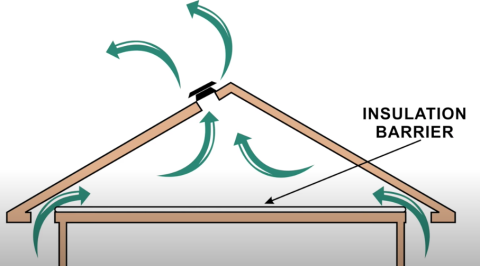
Soffit vents usually allow fresh air to flow into the attic, but they do not provide an exhaust mechanism. The best way to vent a bath fan out of the attic is through a vent in the roof itself. Also, a bath fan that vents directly into the attic is a guaranteed attic mold problem and oftentimes homeowners require professional attic mold removal services as a result.
Blocked Soffit Vents: Proper attic ventilation welcomes fresh air in and pushes moist air out. Generally speaking, attic ventilation relies on the fact that heat rises.
Humidifier Set Too High: Is your HVAC system over-humidifying your indoor air? It is best if you can maintain the relative humidity level within your home to between 40% and 60%.

Attic Ventilation Design and Needs
Poor attic ventilation and insulation deficiencies
may have caused condensation within your attic space. The suspected source of mold in your attic is likely a result of a mixture of mold spores and excessive condensation within the attic space that have settled on organic wood material. The general rule, on the amount of total attic vent space needed, is to have at least one square foot of vent space for every 150 square feet of attic area. Ideally, half the vents should be located in the soffit at the bottom of the roof and half in gable or ridge vents near the top to allow for natural circulation of air through the attic.
Attic ventilation temperature differential
Keeping the air temperature in the attic relatively similar to the surface temperature of the wood is crucial. If there is a differential between the two, you end up reaching dew point causing excessive condensation resulting in mold growth.
How We Treat Mold in Your Crawl Space
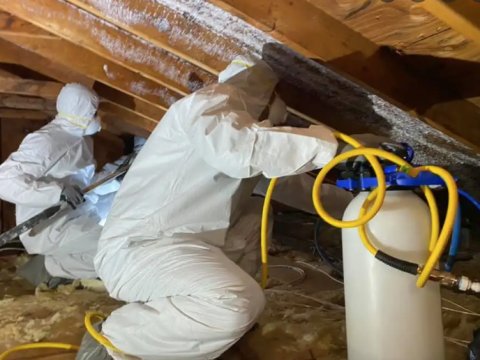
MassMold takes a comprehensive approach to crawl space mold removal. Our thorough inspection allows us to create a plan that is tailored to your home, ensuring effective results. We’ll start by isolating the mold so that it doesn’t spread during the treatment process. Then, we’ll get started on the mold abatement process, which involves a combination of chemical applications and other procedures, to completely eliminate crawl space mold.
You can rest assured that MassMold will do a thorough job with your crawl space mold removal.