Mold Preventing
Home Sale?
Mold Damage From Past Leak?
Mold Smell in Attic, Bathroom, or Basement
CALL US TODAY!
Home Owners
Realtors
Home inspectors
Your Affordable Mold Removal Focused Company
We Identify Mold, Remove, Disinfect, and Seal
We are an owner-operated, mold-removal focused company, that is designed to efficiently and affordably service your mold problem. How? We are NOT a franchised based water/ fire restoration company that focuses on expensive demolition and insurance-based jobs. We open less than 15% of our customers’ walls or flooring. MassMold’s client base is home owners who simply need to remove mold from their homes at a reasonable price.
Not all mold is dangerous! Don’t let other mold testing companies scare you. More scenarios require mold remediation services than simply water-damage events. Other situations that demand swift action by removal and remediation experts include:
- Attic & Basement Mold Removal
- Kitchen & Bathroom Mold Removal
- leaks in plumbing pipes or appliances (dishwasher, toilet, or garbage disposal) that are not noticed or visible
- Rooms, basements, or unseen, dark areas (crawl spaces or attics) where humidity is too high and damp air is trapped for an extended period
- Flooding events where remediation does not begin within 48–72 hours
- Cracks in exterior walls that allow water to seep into the building frame
- Leaks through roofs and exterior siding

Residential Mold Removal and Remediation Services Certified 5 Year Warranty
Mold Remediation Waltham
Mold remediation in Waltham involves identifying, containing, and removing mold colonies from residential structures while preserving the integrity of the building itself. Waltham homeowners face particular moisture challenges due to the area's climate and aging housing stock, making professional remediation essential for both health and property preservation.
The decision about how to handle mold in your Waltham home depends on several technical factors: the extent of contamination, the affected materials, moisture source identification, and whether structural investigation is necessary. This page compares the primary remediation approaches and helps you understand what distinguishes effective service in this market.
Non-Invasive vs. Structural Investigation Approaches in Waltham
The most significant distinction in mold remediation methodology is whether the work requires opening walls and structural components to locate hidden colonies. MassMold specializes in non-invasive assessment and removal, opening walls in fewer than 15 percent of cases. This matters because wall opening generates significant cost, dust containment complexity, and extended project timelines.
Non-invasive methods begin with thermal imaging and moisture mapping using calibrated meters. These tools identify moisture gradients and temperature anomalies that indicate where mold is likely colonizing without requiring destruction. In Waltham's older homes-many built in the early twentieth century with balloon framing and inadequate vapor barriers-this precision approach prevents unnecessary structural disturbance.
When structural investigation becomes necessary, it typically follows failed non-invasive assessment or when active water intrusion is confirmed through the building envelope. Opening walls allows direct visualization of fungal growth on framing, insulation, and sheathing. The decision should rest on evidence, not assumption.
| Approach | When Used | Cost Profile | Timeline | Structural Impact |
|---|---|---|---|---|
| Non-invasive assessment and removal | Surface mold, localized moisture, accessible areas | Lower | Shorter, typically 2-5 days | Minimal |
| Thermal imaging and moisture mapping | Hidden moisture, suspected wall cavity mold | Moderate diagnostic cost | Diagnostic phase 1-2 days | None (assessment only) |
| Targeted wall opening and cavity investigation | Confirmed hidden growth, water damage history | Higher | Longer, 5-14 days depending on scope | Controlled opening with restoration |
| Comprehensive structural remediation | Extensive contamination, multiple areas, severe water damage | Highest | Longest, 2-4 weeks or more | Substantial but necessary |
For most homeowners in Waltham dealing with basement seepage, attic condensation, or bathroom moisture-the three most common mold scenarios in this region-non-invasive remediation paired with thorough moisture source correction eliminates the problem without wall demolition.
Testing and Inspection Standards for Properties in Waltham
Professional mold testing in Waltham follows two distinct but complementary protocols: air quality testing and surface/bulk sampling. Understanding the difference is essential because they answer different questions about your property's condition.
Air quality testing uses calibrated spore traps or particle counters to quantify mold spore concentrations in indoor air and compare them against outdoor baseline samples. Results are expressed as spore counts per cubic meter. This method tells you whether mold is actively releasing spores into occupied space-critical information for families with respiratory sensitivities or immunocompromised household members. A significant indoor-outdoor differential indicates active mold colonization affecting breathable air.
Surface and bulk sampling-collecting material samples from suspected contaminated areas-identifies the specific mold species present and confirms active growth on building materials. A swab from a damp basement wall or tape-lift from visible discoloration goes to an accredited laboratory for microscopic and sometimes culturing analysis. This approach pinpoints contamination location and species, guiding remediation strategy.
In Waltham's older housing, inspection typically combines visual assessment with moisture meter readings in basements, crawl spaces, attics, and around penetrations. Because Waltham experiences significant seasonal humidity fluctuation and freeze-thaw cycling, these areas are primary mold risk zones. Professional inspection documents moisture patterns that reveal whether a moisture problem is temporary (burst pipe, roof leak) or chronic (foundation seepage, inadequate ventilation).
A certified mold remediation company conducting testing in Waltham should provide written baseline documentation before remediation begins, then repeat testing post-remediation to verify that spore counts have normalized and that no new contamination has developed. This creates accountability and proof that the work was effective.
Moisture Source Correction: The Foundation of Lasting Remediation in Waltham
Removing visible mold without correcting the moisture source is temporary at best. Mold will return because the underlying conditions that created it persist. In Waltham, the most common moisture sources are foundation seepage, inadequate attic ventilation, plumbing leaks, and bathroom/kitchen exhaust venting into attic spaces rather than outside.
Foundation seepage in Waltham's older basements typically requires exterior grading adjustment, interior sump pump installation, or perimeter drain cleaning-not just basement mold removal. A professional remediation company should assess the moisture pathway and recommend the source correction, even if they do not perform that work themselves. MassMold identifies these sources during inspection and guides homeowners toward solutions, whether that means regrading, installing dehumidification, or sealing air leaks in the attic.
The remediation guarantee reflects confidence in source correction. A certified five-year warranty on mold remediation work signals that the contractor stands behind their moisture assessment and believes the conditions will remain dry if the homeowner follows recommendations for ventilation maintenance and drain management.
If you are a homeowner, real estate agent, or home inspector in Waltham facing mold questions on a property, the right remediation partner will explain the moisture source clearly, outline non-invasive options first, and provide transparent testing documentation. Reach out to discuss your specific situation-MassMold serves Waltham and the surrounding area with owner-operated expertise focused on affordable, minimally invasive solutions.
Frequently Asked Questions
What causes mold growth in Waltham homes?
Waltham's humid climate, aging housing stock, and seasonal freeze-thaw cycles create persistent moisture conditions. Foundation seepage in basements, inadequate attic ventilation, and improperly vented bathroom/kitchen exhaust are the primary culprits. Because many Waltham homes were built before modern moisture management standards, these issues are nearly universal and require active correction.
Do you have to open walls to remove mold in Waltham?
Not in most cases. Non-invasive assessment using thermal imaging and moisture mapping identifies hidden mold without structural disturbance. Walls are opened in fewer than 15 percent of remediation projects-typically only when evidence confirms active hidden growth that cannot be addressed from accessible areas. This approach saves cost and minimizes disruption to your Waltham home.
How much does mold remediation cost in Waltham?
Cost depends on contamination extent, whether structural investigation is needed, and moisture source complexity. Non-invasive basement or attic mold removal typically ranges lower; extensive structural remediation costs more. Professional assessment and testing provide accurate estimates. Contact a local remediation company for an inspection-based quote rather than phone estimates.
What is the difference between mold testing and mold inspection?
Inspection is visual and moisture assessment-identifying where mold is and why it is there. Testing involves collecting samples and air quality measurements that are analyzed in a laboratory to confirm mold species and spore concentrations. Both are essential: inspection guides remediation strategy, and testing documents baseline conditions and post-remediation success.
Why do basements and attics develop mold so often in Waltham?
Basements struggle with foundation seepage from Waltham's clay soils and freeze-thaw stress on masonry. Attics lack adequate ventilation in older homes and often receive improperly ducted bathroom/kitchen exhaust, trapping moisture in framing. Both areas have limited air circulation and temperature fluctuation, creating ideal conditions for mold colonization.
How long does mold remediation take?
Non-invasive removal of localized mold typically takes 2 to 5 days. Thermal imaging and moisture assessment add 1 to 2 days. Structural investigation and extensive remediation can require 5 to 14 days or longer depending on the scope. Your contractor should provide a timeline based on inspection findings, not a blanket estimate.

FAST AND EFFICIENT PROCESS
MassMold is dedicated to helping you ensure that the property you or your clients want to buy or sell, is free from harmful mold that may pose a health risk if left unresolved.
Once we’ve determined the extent of the issue, we create a detailed plan of action to remove mold, clean your air, and restore your property. This full-service process is performed by highly trained technicians using state-of-the-art equipment, so you can be confident your home’s indoor air quality after our services.
We are passionate about not only identifying problems, but also recommending a course of action to resolve them quickly, so that you can rest assured that the house you are considering buying or selling meets all health and safety standards and is fit for habitation.
Why Do I have Mold in My Attic?
Improper Bath Fan to Soffit and Attic Venting
Soffit vents usually allow fresh air to flow into the attic, but they do not provide an exhaust mechanism. The best way to vent a bath fan out of the attic is through a vent in the roof itself. Also, a bath fan that vents directly into the attic is a guaranteed attic mold problem and oftentimes homeowners require professional attic mold removal services as a result.
Blocked Soffit Vents: Proper attic ventilation welcomes fresh air in and pushes moist air out. Generally speaking, attic ventilation relies on the fact that heat rises.
Humidifier Set Too High: Is your HVAC system over-humidifying your indoor air? It is best if you can maintain the relative humidity level within your home to between 40% and 60%.

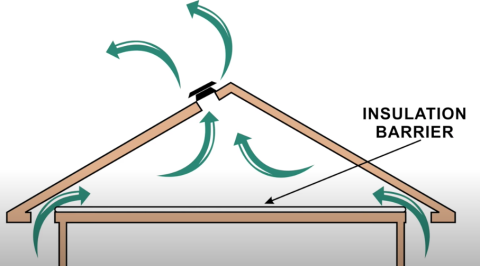
Attic Ventilation Design and Needs
Poor attic ventilation and insulation deficiencies
may have caused condensation within your attic space. The suspected source of mold in your attic is likely a result of a mixture of mold spores and excessive condensation within the attic space that have settled on organic wood material. The general rule, on the amount of total attic vent space needed, is to have at least one square foot of vent space for every 150 square feet of attic area. Ideally, half the vents should be located in the soffit at the bottom of the roof and half in gable or ridge vents near the top to allow for natural circulation of air through the attic.
Attic ventilation temperature differential
Keeping the air temperature in the attic relatively similar to the surface temperature of the wood is crucial. If there is a differential between the two, you end up reaching dew point causing excessive condensation resulting in mold growth.
How We Treat Mold in Your Crawl Space
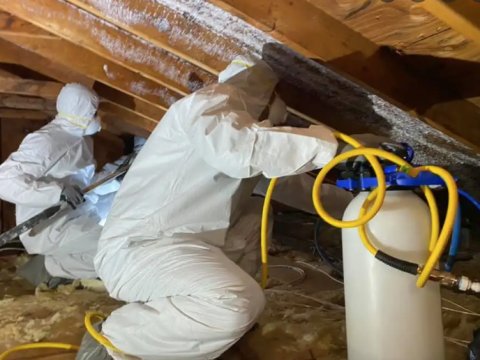
MassMold takes a comprehensive approach to crawl space mold removal. Our thorough inspection allows us to create a plan that is tailored to your home, ensuring effective results. We’ll start by isolating the mold so that it doesn’t spread during the treatment process. Then, we’ll get started on the mold abatement process, which involves a combination of chemical applications and other procedures, to completely eliminate crawl space mold.
You can rest assured that MassMold will do a thorough job with your crawl space mold removal.