Mold Preventing
Home Sale?
Mold Damage From Past Leak?
Mold Smell in Attic, Bathroom, or Basement
CALL US TODAY!
Home Owners
Realtors
Home inspectors
Your Affordable Mold Removal Focused Company
We Identify Mold, Remove, Disinfect, and Seal
We are an owner-operated, mold-removal focused company, that is designed to efficiently and affordably service your mold problem. How? We are NOT a franchised based water/ fire restoration company that focuses on expensive demolition and insurance-based jobs. We open less than 15% of our customers’ walls or flooring. MassMold’s client base is home owners who simply need to remove mold from their homes at a reasonable price.
Not all mold is dangerous! Don’t let other mold testing companies scare you. More scenarios require mold remediation services than simply water-damage events. Other situations that demand swift action by removal and remediation experts include:
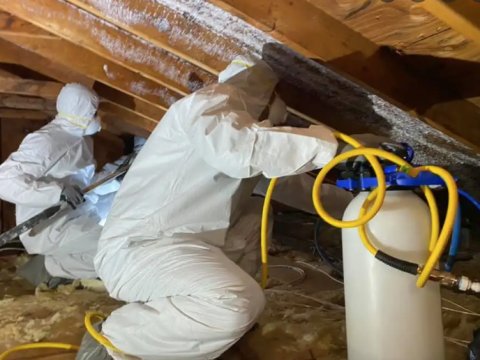
- Attic & Basement Mold Removal
- Kitchen & Bathroom Mold Removal
- leaks in plumbing pipes or appliances (dishwasher, toilet, or garbage disposal) that are not noticed or visible
- Rooms, basements, or unseen, dark areas (crawl spaces or attics) where humidity is too high and damp air is trapped for an extended period
- Flooding events where remediation does not begin within 48–72 hours
- Cracks in exterior walls that allow water to seep into the building frame
- Leaks through roofs and exterior siding

Residential Mold Removal and Remediation Services Certified 5 Year Warranty
Mold Remediation Newburyport
Mold remediation in Newburyport requires understanding both the coastal climate that drives moisture into homes and the specific approach needed to remove it effectively without unnecessary demolition.
The Problem: Water Intrusion and Hidden Mold Growth
A homeowner in Newburyport contacted MassMold after noticing a musty odor in the basement following a month of above-average rainfall. The property, built in the 1970s, had a foundation prone to minor seepage during heavy precipitation-a common condition in the North Shore region where groundwater tables rise seasonally. The homeowner had not visibly seen mold but was concerned about air quality, particularly because a family member had a history of respiratory sensitivity.
A visual inspection revealed no obvious mold on walls or floors. However, the basement framing in one corner showed signs of persistent moisture. Without proper testing, the homeowner faced a choice: assume the problem was minor and monitor it, or invest in comprehensive evaluation to understand the actual scope. The uncertainty created anxiety-any decision made without data risked either unnecessary expense or a health issue left unaddressed.
The MassMold Approach: Testing Before Removal
Rather than recommend immediate wall opening or broad remediation, MassMold began with mold testing and inspection. This is the baseline step that distinguishes a remediation company focused on accuracy from one that defaults to demolition.
The process included:
- Visual assessment of all moisture-prone areas in the basement, including the rim joist, band board, and corner where seepage was observed
- Moisture mapping to identify where water was traveling through the foundation
- Air quality testing to measure mold spore levels inside the home and compare them to outdoor baselines
- Non-invasive sampling behind the rim joist using a small probe to confirm mold presence without opening the wall
MassMold opens walls in less than 15% of cases because testing and moisture control often eliminate the problem without structural demolition.
In this case, testing confirmed active mold growth in the rim joist cavity-the narrow space where the wooden frame meets the concrete foundation. The air quality test showed spore counts elevated above outdoor levels, validating the homeowner's concern. However, the extent was localized to roughly 8 linear feet of the rim joist, not a systemic problem affecting the entire basement.
The Solution: Targeted Removal and Moisture Control
Based on test results, MassMold recommended a mold cleaning services approach that addressed the root cause without removing the wall. The work included:
- Controlled demolition of a 4-foot section of drywall to access the affected rim joist-about one-third of the area that might have been removed if assessed visually only
- Removal of contaminated wood fibers and debris from the rim joist cavity using HEPA filtration
- Application of a mold-inhibiting sealant to the exposed wood and concrete interface
- Installation of a vapor barrier along the foundation band to prevent future moisture accumulation
- Replacement of the drywall with moisture-resistant material and fresh framing lumber
- Follow-up air quality testing to confirm spore levels returned to normal indoor ranges
The entire project took five days. Because the structural opening was limited to the problem area, repair costs stayed proportional to the actual issue. Crucially, the homeowner received a certified warranty covering the remediated area, providing assurance that the work was durable.
The Result: Confidence and Long-Term Protection
Post-remediation testing confirmed that air quality in the basement returned to normal levels, with spore counts matching outdoor baselines. The homeowner's respiratory-sensitive family member reported no lingering odors or symptoms. The moisture barrier now protects against seasonal seepage, which in Newburyport occurs regularly during spring snowmelt and fall nor'easters.
The total cost and timeline were significantly lower than they would have been if the wall had been opened speculatively across the entire basement band. More importantly, the data-driven approach gave the homeowner clarity: the problem was identified, contained, and solved-not hypothetical or ongoing.
This case illustrates why testing matters in mold remediation. Newburyport's waterfront location and older housing stock create genuine moisture risks, but those risks are manageable when addressed with precision rather than assumption. The homeowner avoided unnecessary demolition while fully resolving the health concern.
If you have noticed moisture, odors, or health symptoms that might point to mold in your Newburyport home, contact MassMold for a no-pressure inspection and testing evaluation. They will identify what is actually present, explain your options clearly, and recommend only the work that your home needs.
Frequently Asked Questions
How much does mold testing cost in Newburyport?
Testing costs depend on the size of the area and whether air quality sampling is included along with visual inspection. Contact MassMold directly for a specific quote based on your home's needs. A basic inspection-plus-testing package for a basement or single room is typically more affordable than removal itself, and testing often reveals that remediation scope is smaller than initially feared.
Why does mold grow in Newburyport basements?
Newburyport's maritime climate and seasonal groundwater fluctuations create persistent moisture in foundation areas, especially in older homes with concrete or brick foundations. Water naturally migrates through rim joists, band boards, and foundation cracks, creating the humid environment mold requires to grow. Proper moisture barriers and ventilation control are essential prevention measures.
Does MassMold handle mold in attics and basements?
Yes, MassMold specializes in both attic and basement mold removal, along with comprehensive inspection and testing for any moisture-prone area in a residential home. They use non-invasive methods whenever possible to identify and remove mold while minimizing structural damage.

FAST AND EFFICIENT PROCESS
MassMold is dedicated to helping you ensure that the property you or your clients want to buy or sell, is free from harmful mold that may pose a health risk if left unresolved.
Once we’ve determined the extent of the issue, we create a detailed plan of action to remove mold, clean your air, and restore your property. This full-service process is performed by highly trained technicians using state-of-the-art equipment, so you can be confident your home’s indoor air quality after our services.
We are passionate about not only identifying problems, but also recommending a course of action to resolve them quickly, so that you can rest assured that the house you are considering buying or selling meets all health and safety standards and is fit for habitation.
Why Do I have Mold in My Attic?
Improper Bath Fan to Soffit and Attic Venting
Soffit vents usually allow fresh air to flow into the attic, but they do not provide an exhaust mechanism. The best way to vent a bath fan out of the attic is through a vent in the roof itself. Also, a bath fan that vents directly into the attic is a guaranteed attic mold problem and oftentimes homeowners require professional attic mold removal services as a result.
Blocked Soffit Vents: Proper attic ventilation welcomes fresh air in and pushes moist air out. Generally speaking, attic ventilation relies on the fact that heat rises.
Humidifier Set Too High: Is your HVAC system over-humidifying your indoor air? It is best if you can maintain the relative humidity level within your home to between 40% and 60%.

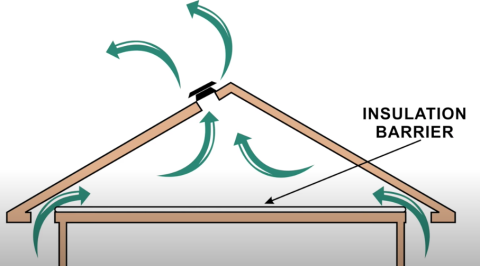
Attic Ventilation Design and Needs
Poor attic ventilation and insulation deficiencies
may have caused condensation within your attic space. The suspected source of mold in your attic is likely a result of a mixture of mold spores and excessive condensation within the attic space that have settled on organic wood material. The general rule, on the amount of total attic vent space needed, is to have at least one square foot of vent space for every 150 square feet of attic area. Ideally, half the vents should be located in the soffit at the bottom of the roof and half in gable or ridge vents near the top to allow for natural circulation of air through the attic.
Attic ventilation temperature differential
Keeping the air temperature in the attic relatively similar to the surface temperature of the wood is crucial. If there is a differential between the two, you end up reaching dew point causing excessive condensation resulting in mold growth.
How We Treat Mold in Your Crawl Space
MassMold takes a comprehensive approach to crawl space mold removal. Our thorough inspection allows us to create a plan that is tailored to your home, ensuring effective results. We’ll start by isolating the mold so that it doesn’t spread during the treatment process. Then, we’ll get started on the mold abatement process, which involves a combination of chemical applications and other procedures, to completely eliminate crawl space mold.
You can rest assured that MassMold will do a thorough job with your crawl space mold removal.